 BHARCS
← The Library
BHARCS
← The Library
I have not been on my farm for a while now, but I visit often. I got to meet the “Front Gate Family” during my latest visit. Some of you know them. The mum’s Chaita, the dad’s Dude and the daughters are Iti and Yaya. I have heard that Chaita and Yaya tend not to hang around if I am not there. But this visit was special. As expected, Dude and Iti were on site. But soon, something special happened. Chaita and Yaya magically arrive.
Chaitha’s always had this unique ability to know when I show up on my site.
Chaitha has always had this unique ability to know when I show up on my site. When I first bought this land three years ago, I’d show up once a week or two, sometimes once a month. But she’d show up. At first, I thought she lived there all the time. Maybe she did, though I hope not. But now, we have construction workers on site and I have been not living on the build site for over 6 months now. Our site manager, Oviya tells me that Chaita is not around when I am not around. Though we have daily feeding rituals now, she does not seem too eager about the food. She does not turn up for it either. She is off, leading another life. A secret life unknown to me. Sometimes Oviya brings clues. But it is not enough to know about her secret life. Maybe once I move back, I need to do some sleuthing. Let’s see. Thoughts on how I can figure out what is going on when I am away?
If birds and humans can sign their joy, perhaps dogs can too right?
Anyways, back to this visit. The mysterious girls arrived and their body language suggested they knew I was on site. They looked for me, came running up and complained very loudly. Or maybe they sang their joy. If birds can sing their joy and if humans can sing their joy, perhaps dogs can too, right? I am not sure what it was, but it was a special welcome reserved for long overdue special visitors. It feels so good and perhaps that is the intent of such expression of joy. I got some lovely pictures!
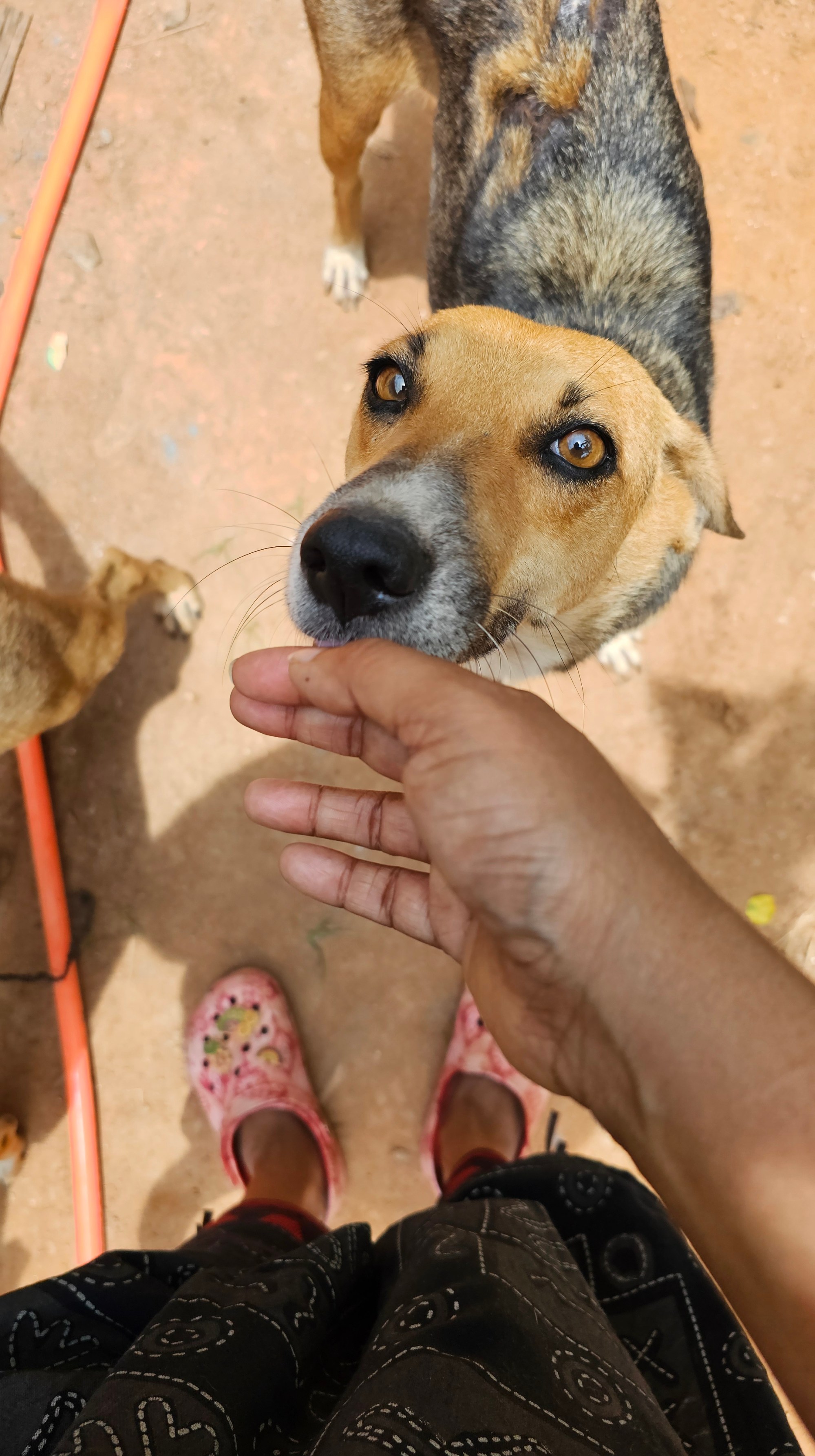
It’s “Yaya Chaita” now, but you can call her Yaya.
I shared pictures of them and captioned them as as “Meet Ms. Bright Eyes Chaita and daughter Yaya. And yes, we’ve made Chaita the family name now. So it’s “Yaya Chaita” now, but you can call her Yaya.”. Oviya gently chides me that this picture is of Iti, not Yaya, which serves me as a reminder that I need to go back to the farm now. Sigh!
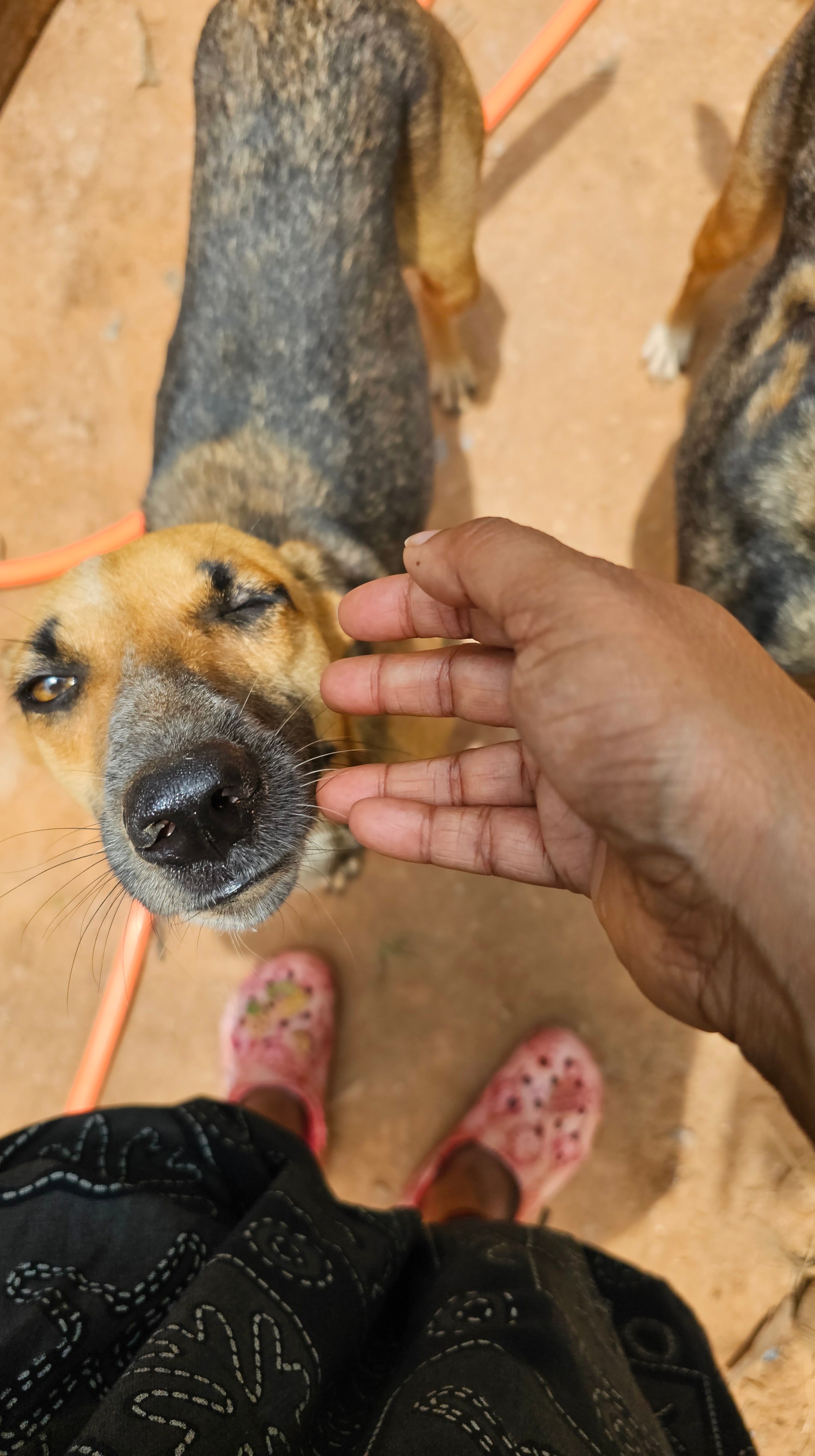
Dude gains strength from his family!
Oviya also banters that “she likes “Yaya Chaita”, better than “Yaya Dude”. I suspect Dude may not be her favourite of this lot. I can understand why. While he’s shy, he wrecks havock on the farm. He jumps into our lily pond, kills the lily plants, jumps out and rolls in the mud, rips apart anything remotely edible left on sight, including the all-purpose-flour that we were using to make gum. But he’s a hoot. I mean look at him! His ears don’t match and he looks like someone slapped him with muddy fingers on both cheeks. But there’s more to this dog. Sure, he’s shy and does not risk humans touch. But he gains strength from his family to cope his fear often. As his sisters fuss around humans, he shows up, keeps a close eye on them, using their reactions to alert himself, musters the courage to approach and attempts to touch us or invites us to touch him briefly and respectfully.
When I met him, it was evident he was wary of human touch.
If I were to think about touching beings I am afraid of …
When I first met him, it was evident he was wary of human touch. But as he witnessed his mate, Chaita and their daughters Iti and Yaya prance around me, he started to get curious. He finally started to ask for touch. Looked like he was getting curious as to why the girls seem to love it so. So he decided to try it. But his way was interesting. His first contact with me was him holding my hand gently between his teeth. It felt like if was going to try this “human touch”, it had to be him touching me, not the other way around. And that would make sense if we think of similar fears. If I were to think about touching beings I am afraid of (reptiles with legs)…ugh! But if, IF, I were to ever entertain the idea of touch, it is likely only possible if I feel in control, so it is me touching the lizard, not the other way around. I’m going to put aside the ethical questions this brings up for now and instead seek in this an explanation for why Dude wanted to touch me, not the other way around. Suddenly, it makes sense to me. Duh!
I feel he was doing the equivalent of “hedging his bets”!
But by choosing to hold my hand in my mouth, I feel he was doing the equivalent of “hedging his bets”. If this human touch turned out to be as bad as he had believed and feared, then it may work in his favour if my hands were between his teeth. Fortunately for him and me, my touch was gentle and pleasant. So he invited me to touch him on his neck. But he set up stringent boundaries and I have no problem respecting it. So, it works for us, in in our own unique way. Thus started our respectful friendship.
With most interactions, I do gain more of his trust. But that is so precariously balanced that on some, I lose it. Over all, however, our relationship is evolving. He will never be a Chaita! But he’s an awesome version of Dude, who repeatedly choses to cope with his fear with the help of his family. He will NOT do so alone. But with the girls around, he will let me touch him a little. Even ask for it. That’s pretty brave of him. I do not think I am as brave. I cannot get myself to touch beings I am afraid of, despite cognitively knowing they cannot hurt me. But Dude…he does it over and over…based on what? Faith? Reasoning? Sure I could cite studies that may support the notion that my brief touch triggers a feel-good physiological feedback loop. Thus the touch is rewarding and thus this is good-ol conditioning. But parking the science aside… it does not add up. A brief moment of my touch, so powerfully rewarding to overcome fear? Magic touch huh? Possible, I suppose, but not probable.
It may be possible that such magic touch exists and ours is that to dogs, but…
It may be possible that such magic touch exists and ours is that to dogs, but I wonder if explanations other than “magic touches” exist. I suspect they do, but what are they?
I would love for us to use this to explore ideas like the role of choice in coping with fear. But in order to do it, we must recognise the choices Dude is exercising here and the value they hold for him in his process. But to do so, we must look past Operant Conditioning as the only form of learning. But having witnessed the kind of resistance to such exploration, despite adequate science to support alternatives, I wonder, why we’d rather believe in “magic touches”, over “Dude’s courage”? Does Dude’s courage expose our insecurity or is our insecurity warranted, given how fragile the argument for human exceptionalism is and how much we need to this argument to hold, in order to morally justify our exploitative practises? Does Dude know his little act of bravery holds such profound implications? Does it matter to him?
I think there is a lot, we professionals can learn from Dude about how animals over come fear. And in pondering over his story, we get an opportunity to look into the “animal mirror”, to learn about ourselves and our own relationship with fear and power.
This is an invitation to ask ourselves questions…
- How is my process of coping with fear different from Dude’s?
- Can I learn a trick or two from him that I may try in my own journey with “scary beings”?
- Or I rather, “chicken out” of such lofty ambitions as touching those we are afraid of and instead just chose to humbly admire his courage from afar. (P. S. I chose the latter)
- Do our “captive or pet dogs” have the opportunity to have such relationships with fear? I often find that the bar is a little too high for them. They do not get to “chicken out” as often (or should it be “human out”, based my courage) . They are mandated to “get over it”, if not through rewards, then though punishments. Well, to rephrase that, they are mandated to behave as if they have gotten over it. The bar seems a bit high for me, not to me, but for me. I personally can’t scale a bar that high.
- There seem to be ways to navigate around fears that do not always require us to “conquer” it. Dude shows it. My “non-touch and observe from respectable distance” attitude seem to be my way to navigate around my fear. Do “pet dogs” get such space to navigate? Do they need it and deserve it?
- How does that space look?
- What Dude’s story tell us about learning, human exceptionalism and anthropocentrism?
What else can we ask ourselves? I have become increasingly fond of the idea of the animal mirror. As Donna J. Haraway says “We polish an animal mirror to look for ourselves”[1]. It is indeed a powerful idea to me. So, what else should we look for about ourselves, in this mirror?
References
- Haraway, D., 1978. Animal sociology and a natural economy of the body politic, part II: the past is the contested zone: human nature and theories of production and reproduction in primate behavior studies. Signs: Journal of Women in Culture and Society, 4(1), pp.37-60.