 BHARCS
← The Library
BHARCS
← The Library
My paper, The Open Palm Gesture in Human–Dog Communication: An Exploratory Synthesis, has just been published and it's over 14,000 words! So, here's a shorter version, for those who are interested in the central idea but not necessarily in reading the full paper. Academic papers are written not only to present an idea, but also to situate it within existing literature, justify every argument, and support every claim with evidence. But practitioners do not need that rigour, so I thought I would write a much shorter version here, specifically for practitioners. I believe the idea is powerful and useful and so I would love to make it more accessible through this blog.
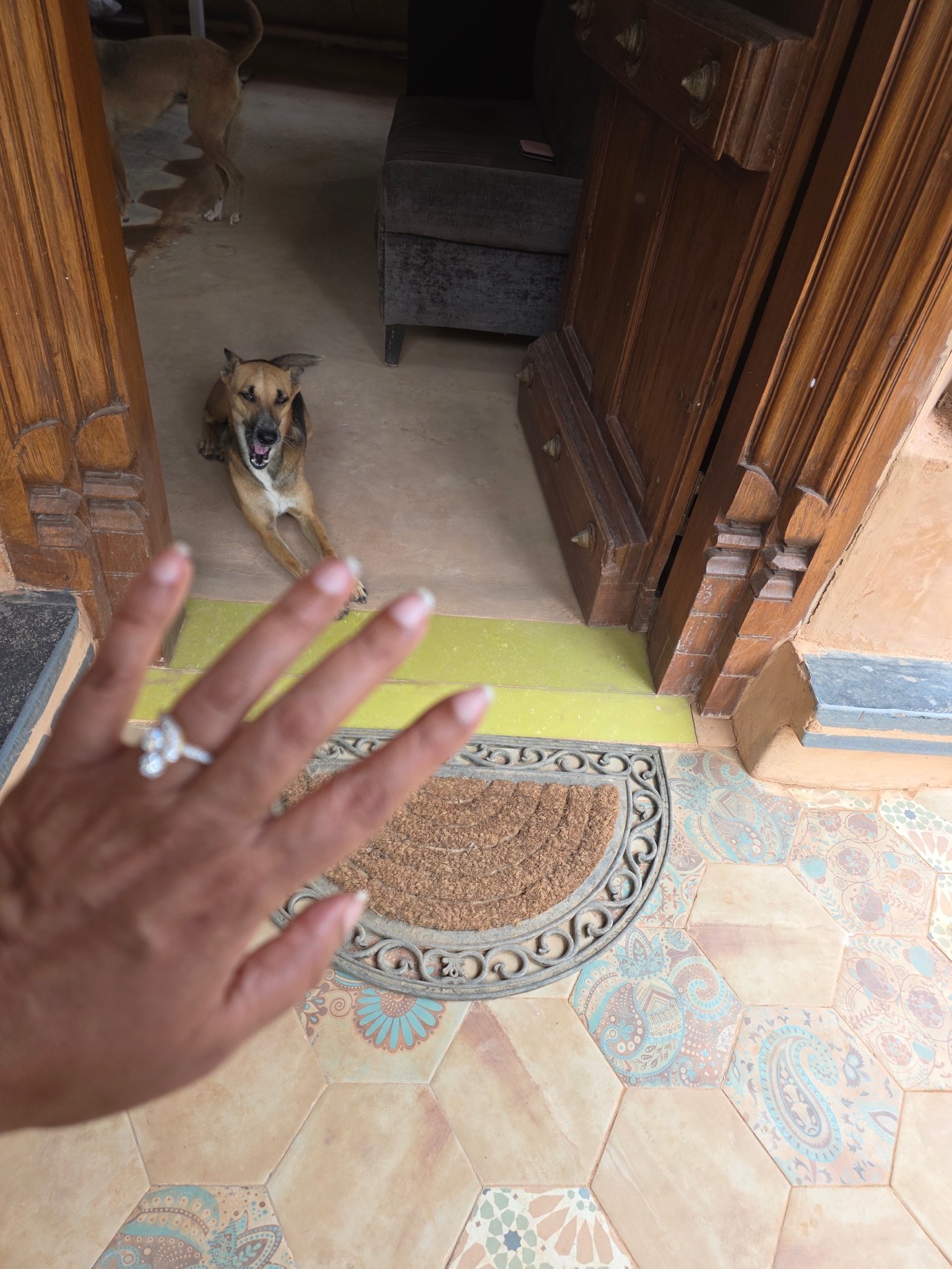
The paper asks a few simple questions: Could the open palm gesture be an important but underexplored part of human–dog communication? If yes, what are its applications and boundary conditions?
What this paper does is to ask the above questions and provide possible answers to it, because I believe that these answers are important for practitioners like us, who want to work force-free with dogs. Wouldn't a gesture that helps dogs regulate their emotions be a powerful tool in our hands? Hence, my interest in this question.
The open palm is one of humanity's oldest gestures. It appears across cultures, has deep evolutionary roots, and has long been studied by gesture researchers. It is part of the everyday communicative repertoire of people all over the world. Gesture studies show us that humans are such prolific users of this gesture that even people who claim not to use it, use it.
So, that's the first part to understand - we use this particular gesture a LOT. Next we have to examine how we use it. Imagine a traffic policeman stopping traffic with his palm facing the traffic. That's the gesture in essence, but there are variations to it. It is used in different contexts to mean several things. Such gestures are called polysemous gestures. The different meanings of such a gesture emerge based on how it is paired with other modalities of communication like tone, voice, facial expression, posture etc. So if you point the palm out stiffly at someone, you may be saying "HALT! Do not proceed", but if you raised it obliquely towards someone, smiled and with soft eyes, you may be saying "It's okay, don't worry". If you held your hand out next to you, palm facing someone behind you, you may be saying, "stay back, I got this. I will protect you". Look at the images below for some examples of how we tend to use this gesture. You'll get the idea. Your voice, face, eyes, smile, orientation of the palm, how stiff your body is...all that matters.
Consider this provocative quote by Tinbergen (1968): "It is humiliating to us ethologists that many nonscientists, particularly novelists and actors, intuitively understand our sign language much better than we scientists ourselves do." This quote moves me to consider popular media and quotidian usage of the gesture to gain more insight. What does such consideration reveal?
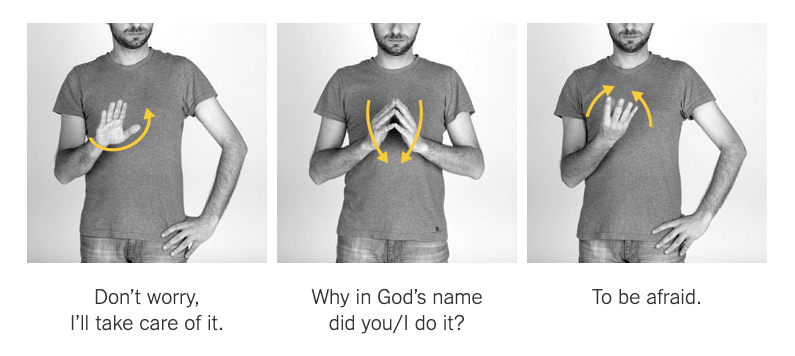
An NYT article on Italian gestures shows a reassuring use of the OPPG. The excerpt is reproduced here because the newspaper's own caption is the evidence: it independently records how this gesture is glossed in ordinary usage. Click the image to read the article (Donadio, 2013).
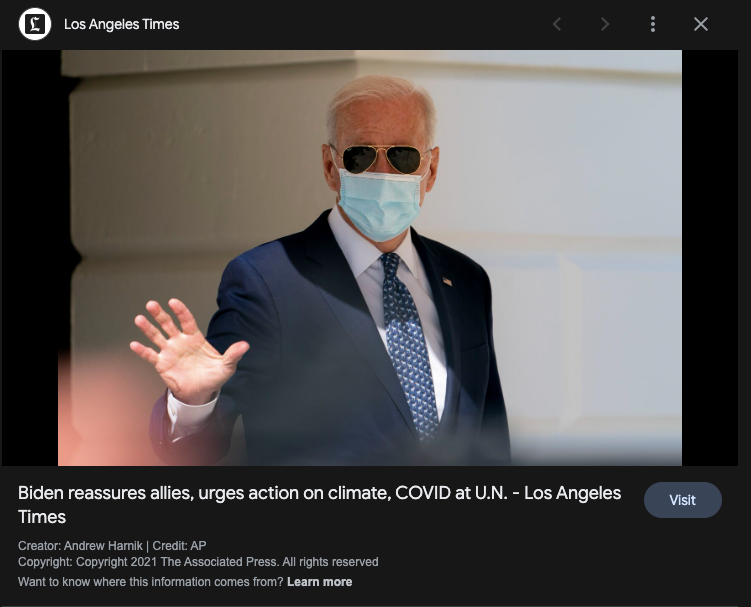
This screenshot shows Google's search results for the headline "Biden reassures allies, urges action on climate, COVID at UN". Although the linked article does not use this image, Google pairs the headline with a photograph of the OPPG. Is the gesture functioning as a visual cue for reassurance? What is being examined here is the image–text pairing produced by the search interface itself, rather than the underlying photograph.
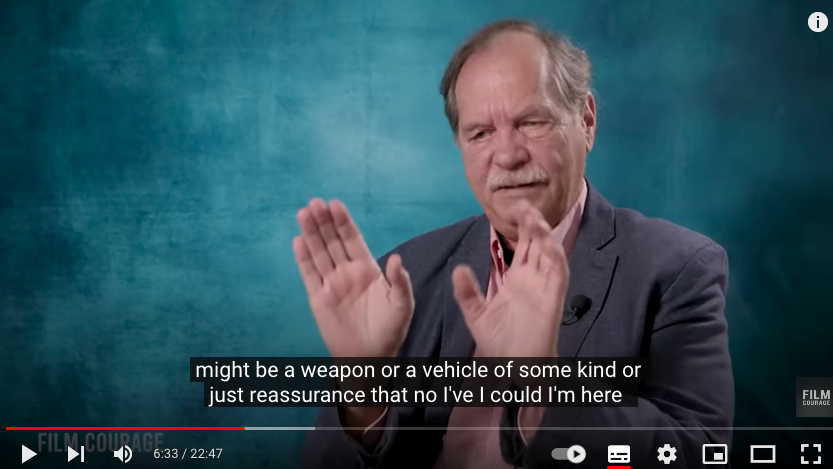
This is a screenshot of a video in which the speaker uses the OPPG when he refers to reassurance (@filmcourage, 2023). Click the image to watch from that moment.
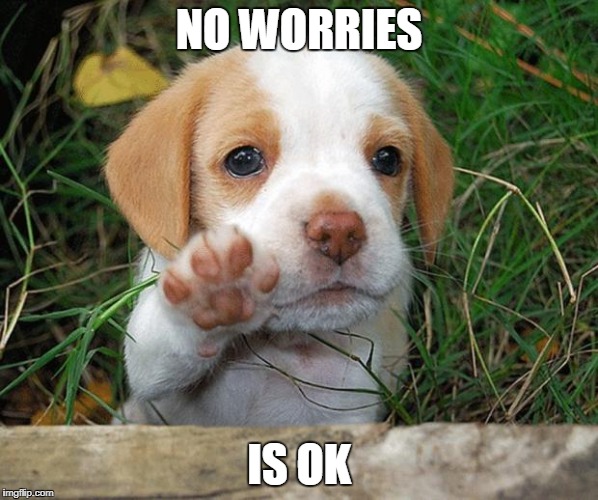
The following are examples of internet memes communicating similar ideas with the OPPG.
Does the message of reassurance extend to our anthropomorphic portrayal of animals, too (Akeller, 1998)?
Okay, so now that we know what kind of gesture we are talking about, the next part is to ask what happens when dogs encounter this gesture. To answer this, we switch to the field of cognitive behaviour and natural history of dogs. Studies in this field show that because dogs have spent thousands of years living alongside humans, they have become extraordinarily good at reading us. We already know they attend to our gaze, our body orientation, our pointing gestures, our facial expressions and our emotional states. If dogs are so skilled at reading human communication, it seems reasonable to ask whether one of our most common and ancient gestures might also hold meaning for them.
This is where we switch gears to examine everyday uses of it. The paper has several videos of the gesture being used, some deliberately and some perhaps not so deliberately.
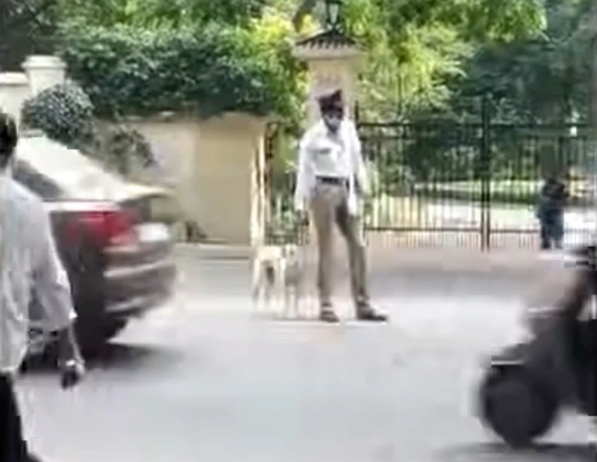
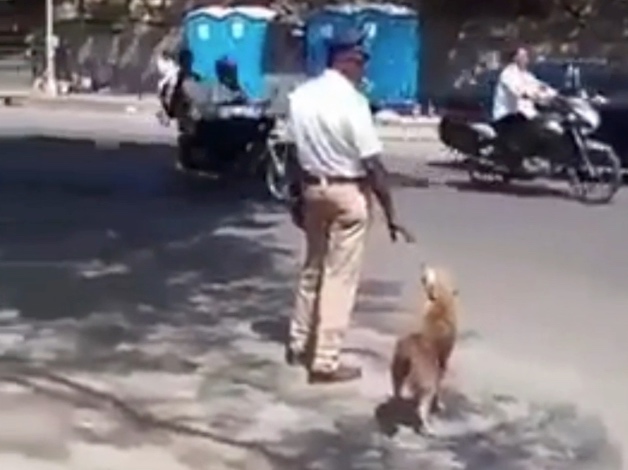
These two images above are screenshots from two viral videos showing traffic police using the gesture on street dogs. While the images are not very clear, the video is very telling (Video 1, Video 2).
What we see across these examples is that it indeed does seem to have an affect on these dogs, one of calming, reassuring, reducing arousal or de-escalating. I have not been able to ascertain exactly what the affect is, but it is roughly along these lines, which is true of how it is used among humans too. There isn't one single meaning to it, but it is a few related ideas that can get communicated based on context. Pilot studies examining the pulse of a dog during the use of this gesture show a reduction in pulse of a dog, supporting similar ideas. The supplementary material provided with the paper gives you links to all these videos and a frame-by-frame analysis of what you see in these videos. I encourage you to go over these slowly, watching the videos in slow motion, to analyse the videos for yourself. You will find useful tips on how you can use these gestures if you analyse these videos.
Okay, now coming back to the paper, the paper also brings up an academic pet peeve. It argues that most scientific work on human gestures and dogs has focused on directive gestures — gestures that tell a dog where to go, what to look at or what to do. But the open palm appears to belong to a different family. Across cultures, people often use it not to direct behaviour but to reassure, calm, slow interactions down or create emotional safety. The paper explores whether dogs may also be responding to this affective use of the gesture. Notice the wording. It explores the possibility. It does not claim to have settled the question.
The argument in the paper is built around a series of observations.
- Humans use the gesture extensively.
- Dogs live immersed in human communication.
- Dogs are exceptionally skilled at interpreting human social signals.
- Qualitative observations, together with preliminary physiological evidence, suggest that the gesture may influence dogs' emotional state.
Taken together, these observations suggest that the open palm gesture deserves much more scientific attention than it has received.
One of the things I enjoyed most about writing this paper was that it sits at the intersection of many different fields. To build the argument, I found myself reading canine cognition, attachment theory, gesture studies, anthropology, communication, developmental psychology and evolutionary biology. It is trying to make a careful, evidence-based argument for why a familiar gesture deserves to become a subject of future empirical research.
Ultimately, this paper is not about claiming ownership of an idea or introducing something that has never existed before. The open palm gesture has long been recognised and used by people who live and work with dogs. My paper does not seek to introduce the gesture. It seeks to understand it through an academic lens. It is about taking something that has been quietly present in human communication for a very long time, noticing that dogs appear to participate in it too, and asking whether science has overlooked something worth investigating.
Sometimes research begins not with discovering something entirely new, but with looking more carefully at something that has been in front of us all along. This paper intends to democratise this knowledge and make it available to a wider audience who can put this insight to good use to improve the well-being of dogs.
@filmcourage, 2023. 12 Stages Of The Hero's Journey - Christopher Vogler, YouTube. Available at: https://www.youtube.com/watch?v=oNNaMuBOxv4 (Accessed: 21 March 2024).
Akeller, 1998. No be sad., Imgflip. Available at: https://imgflip.com/i/23ks14 (Accessed: 23 March 2024).
Link to paper: https://www.cabidigitallibrary.org/doi/10.1079/hai.2026.0031
Click here to download supplementary material with video links and analysis.