
Are free-living dogs causing conflict with wildlife—or are they quietly preventing far more dangerous encounters between humans and wild animals?
Recent media coverage, including the New York Times article “Feral Dogs on the Roof of the World” and its subsequent echo in Indian newspapers, frames Ladakh as a site of growing conflict between humans, snow leopards and “feral dogs.” The narrative is compelling, but incomplete. It isolates dogs as the problem while overlooking their long-standing role as protectors, sentinels and ecological buffers in human-dominated landscapes.
A closer look—grounded in field research, pastoral practices and dog ecology—reveals a very different story.
Ladakh: dogs as guardians, not intruders
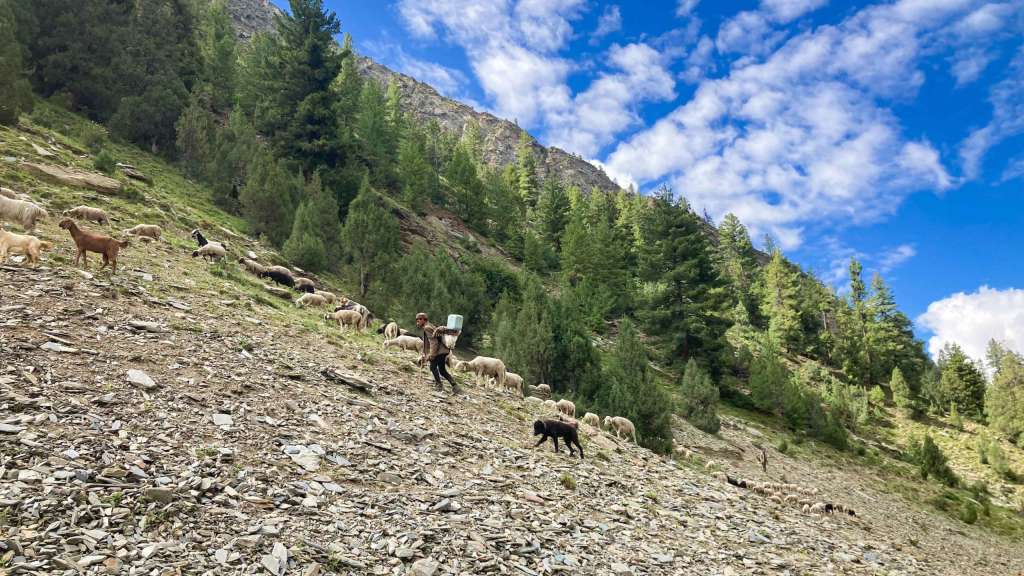
In Ladakh, free-living dogs are often portrayed as antagonists to wildlife. Yet on the ground, many of these dogs function as livestock guards and early-warning systems for pastoral communities.
As researcher Rashmi Singh Rana, who has worked closely with Himalayan pastoralists, points out, dogs in this region are actively used to protect herds and camps. They alert people to approaching predators, confront threats, and in many cases lose their lives while defending livestock from snow leopards, wolves and bears. These deaths—rarely acknowledged in media narratives—underscore that dogs are often victims of conflict, not its drivers.
Scientific studies from villages around Leh reinforce this complexity. Livestock mortality in the Trans-Himalaya is caused by multiple factors: weather events, disease, snow leopards, wolves and free-ranging dogs. Dogs account for a minority of losses, and their activity is concentrated close to villages and corrals—precisely where humans expect safety (Pahuja & Sharma, 2021). This spatial pattern reflects dogs’ role as human-associated sentinels rather than roaming, wild predators.
Himalayan guardian dogs and pastoral coexistence
The role of dogs as protectors in the Himalayas is not new. Pastoral communities across the region have long relied on indigenous livestock guardian dogs—large, vigilant animals bred and trained through experience to deter predators.
Ethnographic and conservation work documents how these dogs function as a non-lethal, low-cost conflict-mitigation strategy, improving tolerance toward wildlife while safeguarding livelihoods (Rana, 2025). Each shepherd camp typically keeps multiple dogs, especially to guard livestock at night. Shepherds learn to interpret different barks as specific alerts, creating a shared language of risk.
Crucially, these dogs are not confined pets. They live free-ranging lives because the skills required to deter wolves, bears or snow leopards cannot be learned indoors. This system are similar livestock-guardian dog practices in Europe and Central Asia to the extent that the dogs roam with herds and camps rather than live within households.
Informal relationships, not neglect
These human–dog relationships are often misread as abandonment. In reality, they are informal partnerships: dogs are fed enough to remain close, allowed to roam to perform their alerting roles, and tolerated as part of everyday life.
Such arrangements are consistent with what behavioural research tells us about dogs. Free-ranging dogs are not failed pets or re-wilded wolves; they are domestic animals whose ecology is tightly bound to humans, their waste, and their settlements (Coppinger et al., 2016; Bhadra & Bhadra, 2020). Across cultures, dogs have historically lived alongside people in exactly these kinds of loose, functional relationships.
The Nilgiris lesson: when dogs disappear
The Nilgiris Biosphere Reserve offers a cautionary example of what happens when dogs are removed without addressing the ecological niche they occupy.
In towns like Coonoor, the absence of dogs is often celebrated as the end of a “dog menace.” But this absence has been followed by the rise of new and far more dangerous conflicts: monkeys raiding homes, bears attempting to enter kitchens, leopards and panthers wandering into residential areas, and even tigers moving through golf courses (Ganesh, 2024).
Local accounts describe people resorting to air guns loaded with pepper kernels to drive animals away—an act born of fear and lack of alternatives. This pattern aligns with ecological research: when a mid-level scavenger and sentinel species is removed, the niche does not remain empty. It is quickly occupied by other animals, often larger, more dangerous, and much harder to manage (Hughes & Macdonald, 2013).
Urban echoes: monkeys on dining tables
The same dynamics play out in cities.
In Bengaluru, monkeys routinely enter high-rise apartments, carrying zoonotic disease risks into kitchens and bedrooms. Leopards have also been spotted in places like schools. These are animals we are ill equipped to share space with, resulting in harm to both human and animal. Dogs, by contrast, are socially legible, easy to vaccinate, embedded in citizen-led monitoring networks, and far less likely to enter enclosed human spaces.
Removing dogs while tolerating monkeys, rodents or other scavengers is not a victory for public health—it is a gamble.
Dogs as biobuffers
Ecologists increasingly describe free-living dogs as biobuffers—animals that stand between human settlements and wildlife.
They perform multiple functions simultaneously:
- early warning through barking and scent detection,
- deterrence of wild animals approaching homes and fields,
- competition with other scavengers such as rats and monkeys,
- rapid consumption of edible waste that might otherwise attract larger carnivores.
Decades of research show that dogs’ presence, behaviour and density are shaped by human systems—waste management, food availability and settlement patterns—not by wilderness ecology (Butler & du Toit, 2002; Majumder et al., 2016). This makes them unusually manageable through vaccination, sterilisation and citizen participation.
A 40,000-year collaboration
The dog–human relationship is one of the oldest coevolutionary partnerships in our species’ history. Archaeological and anthropological work suggests that dogs played a critical role in human survival by outsourcing vigilance, tracking and protection.
Some theories even propose that this partnership reshaped human biology itself—freeing humans to develop speech, cooperation and large-scale social organisation. For most of this shared history, dogs were not confined pets. They were free-living collaborators.
What we see today in villages, pastoral landscapes and forest edges is not an anomaly—it is continuity.
Rethinking “conflict”
The real drivers of human–wildlife conflict are complex: climate variability, disease, land-use change, waste, tourism and livestock practices all interact. Dogs are one part of this system, not the villain.
Across landscapes—from Ladakh to the Nilgiris to Indian cities—free-living dogs often mitigate conflict, absorbing risk and providing early warning in ways humans alone cannot. When they are removed without systemic change, the result is not safer environments, but more volatile ones.
If we are serious about coexistence—with wildlife, with dogs, and with each other—we must stop treating dogs as disposable intruders and start recognising them for what they have long been: shields, sentinels and partners at the human–wildlife frontier.
References / Further Reading
- Bhadra, A., & Bhadra, A. (2020). Humans dominate the social interaction networks of urban free-ranging dogs in India. Frontiers in Psychology, 11:2153.
- Butler, J. R. A., & du Toit, J. T. (2002). Diet of free-ranging domestic dogs in rural Zimbabwe. Animal Conservation, 5, 29–37.
- Coppinger, R., Coppinger, L., & Beck, A. M. (2016). What Is a Dog? University of Chicago Press.
- Ganesh, G. (2024) The dawn of Bear Island • coonoor&co, Journal Coonoor&Co Slow, Sensorial, Sustainable Living from the Mountains of the Nilgiris. Available at: https://coonoorandco.com/journal/the-dawn-of-bear-island (Accessed: 08 January 2026).
- Hughes, J., & Macdonald, D. W. (2013). A review of the interactions between free-roaming domestic dogs and wildlife. Biological Conservation, 157, 341–351.
- Majumder, S., et al. (2016). Denning habits of free-ranging dogs reveal preference for human proximity. Scientific Reports, 6, 32014.
- Pahuja, M., & Sharma, R. K. (2021). Wild predators, livestock, and free-ranging dogs in an urbanising Trans-Himalayan landscape. Frontiers in Conservation Science, 2:767650.
- Rana. (2025, March 18). Himalayan Guardian Dogs: Unsung Sentinels of the Shepherds of Himalaya. RoundGlass Sustain. https://roundglasssustain.com/wild-vault/himalayan-guardian-dogs
About The Authors

Rashmi Singh Rana
Rashmi Singh Rana is a conservation scientist and PhD candidate at the University of Technology Sydney’s Centre for Compassionate Conservation, specializing in the socio-ecological dynamics of multispecies coexistence in the Indian Trans-Himalaya. Affiliated with the Nature Conservation Foundation, her research focuses on the complex interactions between humans, free-ranging dogs, and threatened wildlife in high-altitude agro-pastoral landscapes. Supported by organizations such as the Rufford Foundation and The Habitats Trust, she works extensively in regions like Lahaul to develop community-led conservation frameworks and mitigate human-wildlife conflict through site-specific evidence and traditional ecological knowledge.

Sindhoor is a canine behaviour consultant, a canine myotherapist, an anthrozoologist and an engineer by qualification. She researches free living dogs in Bangalore, India. She has presented her findings at major international conferences in the US, UK and has conducted seminars in Europe, UK and South America. She has been invited as an expert on several podcasts, including a few on NPR radio. She maintained a weekly column on dog behaviour, in The Bangalore Mirror for two years. She is a TEDx speaker, the author of the book, Dog Knows. National Geographic calls hers a ‘Genius Mind’ in the bookazine, Genius of Dogs. She is currently the principal and director of BHARCS. BHARCS offers a unique, UK-accredited level 4 diploma on canine biosociopsychology and applied ethology.
 The BHARCS Blog