
Thanks to a generous gift from a friend, I got to spend some time with my sister. I loved my time with her. We did some fun things and had some lovely conversations. One such conversation struck me as particularly meaningful in light of how we deal with dogs. This blog is about that conversation, but before I dive into that, a bit about my sister…
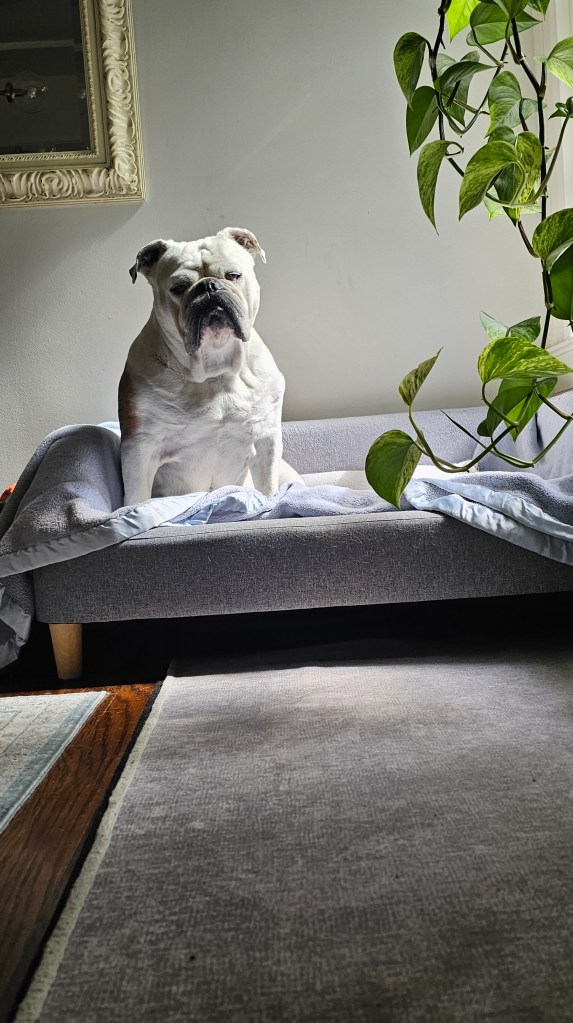
“long pothos plant”
She loves plants and animals! Her house is overflowing with plants. It all apparently started with one little plant in a pot. But now all her plants seem to grow very fast and big and even have babies. Naturally, my first question to her was if she was using some special product. She shut her eyes tight, shook her head from side to side, laughing and said, “No! I don’t use any product on them. We can’t figure out what exactly is happening. But suddenly my plants…” and she looks all around her and proceeds to lovingly stroke her long pothos plant!
I observed her over the next few days and found that she paid the plants a lot of attention. She spent time each day, just looking at each of her plants, touching them gently and generally looking lost in their world. I pointed this out to her and she pondered over it. Then one day, she muttered, “You know, people get it wrong when they talk about giving attention to plants. They think it is about water, sunlight and nutrition. It is not. It is about attention-attention! You actually need to give them attention. You need to look at them, feel them. Then they tell you what they like and don’t like. It’s that simple. I am not doing anything special. I just listen to the plants. Plant language is really simple. Human language is complicated. We complicate things. Their language is quite simple actually. It’s easy. Watch them.”
My heart skipped a beat. What a nice way to capture exactly what we say about dogs at BHARCS. Dog language is not as simple as “plant language”. But it is not as complicated as human language either. But we must learn to watch them. Watch them with loving, caring eyes. They need “attention-attention”. Once we are able to give them that, a lot of questions are answered for us.

But this message cuts deeper. It is true of humans too, is it not? I am in a very pensive and reflective phase in my life. I have been spending a lot of time thinking about the various interactions I have had with people over the years. Some interactions made me feel isolated, some felt transactional and some created moments of connection. I looked closer at the ones that made me feel connected and I felt that these moments were not of me engaged with material things. They were not moments where I was shopping or at a fancy restaurant. The moments of connection seem to have happened when someone makes me feel seen…makes me feel like my pain and my joy are seen. It makes me feel like they are paying “attention” to my soul. In these moments, I also feel a little bit healed, a little loved, a little lighter…So, perhaps, what we need for our inner selves to thrive is for our authentic selves to be seen; for our pain and joy to be seen. We too perhaps need “attention-attention”, not just food, medicines and other kinds of interventions. Perhaps, the language of souls is also simple.
Of course, not everyone wants to be seen. Even those who want to be seen may not want it all the time. Being seen is not the same as being subjected to uncomfortable and constant gaze. But when we see another with care, we notice the discomfort and we know when to stop looking and when one wants to be seen. So, the caring gaze is not to be mistaken with other forms of non-consensual gaze that make people uncomfortable. Here, we are talking about a caring gaze that recognizes and respects the need for space. And, if you have felt better in the presence of this caring gaze, then I invite you to use that feeling to think about the idea of “attention-attention”. What does it mean for you? When do you feel seen in a way that comforts you? Have you tried “seeing” another person, such that they feel seen or heard (not in a creepy way, obviously…duh!)? Does this transform them in any way, even if for a moment? How about your dogs? When are moments they may feel seen in a comforting way?
These days, I am pausing to pay attention to the smaller details of my interactions with others. I feel like this is adding a certain richness and depth to my relationships. However, I must point out that this is slowing down my interactions and is creating what seems like a “low volume of output”. The old “corporate” version of myself has to learn to make peace with this new pace. But it is not a hard lesson to learn at this point because of how it is enriching my relationships with dogs, humans and myself. It’s worth it for me to pay “attention-attention” because I like what I see and how it feeds into who I become.
But these personal reasons apart, I also think these questions are critical at the juncture that the animal training world is at. There are ever-increasing questions about the dog’s perspective on the kind of care we provide for our dogs and we must ask ourselves what it takes to understand the perspective of another sentient being. I know I started this blog by talking about plants. “Plant sentience” is a hotly debated topic and it is a detour we need not have to take in this discussion. Instead, let’s go back to the central idea of “attention-attention” and ponder about it because it has the potential to reveal a lot to us about our dogs’ perspective, and if my experience counts, it has the potential to reveal a little something about ourselves too. Do try it and tell me what you see and how it feels.
About The Authors

Sindhoor is a canine behaviour consultant, a canine myotherapist, an anthrozoologist and an engineer by qualification. She researches free living dogs in Bangalore, India. She has presented her findings at major international conferences in the US, UK and has conducted seminars in Europe, UK and South America. She has been invited as an expert on several podcasts, including a few on NPR radio. She maintained a weekly column on dog behaviour, in The Bangalore Mirror for two years. She is a TEDx speaker, the author of the book, Dog Knows. National Geographic calls hers a ‘Genius Mind’ in the bookazine, Genius of Dogs. She is currently the principal and director of BHARCS. BHARCS offers a unique, UK-accredited level 4 diploma on canine biosociopsychology and applied ethology.
 The BHARCS Blog
I love this blog- to me , as I read your words it spoke of the language that words so often cannot express, the language of feeling, the language of empathy, the language of being, the universal language of connected energy that joins us to our Dogs, other creatures, each other and yes to the plants too- “attention – attention” is such a lovely choice of words for this springboard that launches us into a world where we begin to truly understand the “other” whether that other is our Dog, our Cat, our Parrot, the wild creatures who live all around us, the Humans we encounter, and of course the plants too – in a way we all are one and in the stillness of that oneness we can catch glimpses of our energy flowing, and be touched by it, in a manner that begins to open the doors of communication on a deeper level with other species and with plants too- With our Dogs, of course, we have learned at least some of their body language, however, I believe that we still have so much more to learn, and the deeper we explore the possibilities that you speak of, in this blog, the more I feel that we grow to understand other sentient beings around us – I am now in my 66th year and I am only now, since my retirement beginning to take the time to feel and understand a little about that connection – your blog helped me to understand the connection a little more deeply, thank you for writing it and for sharing it with us ❤️
LikeLike