
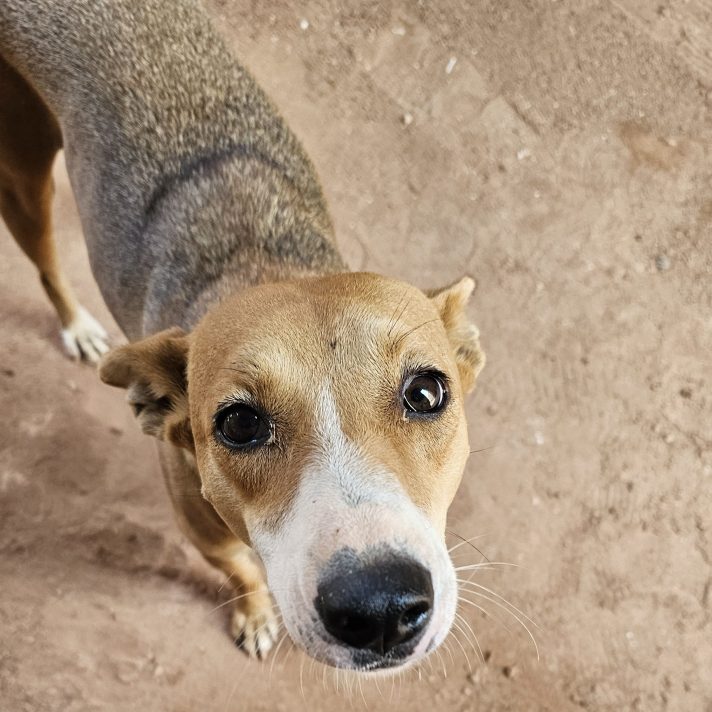
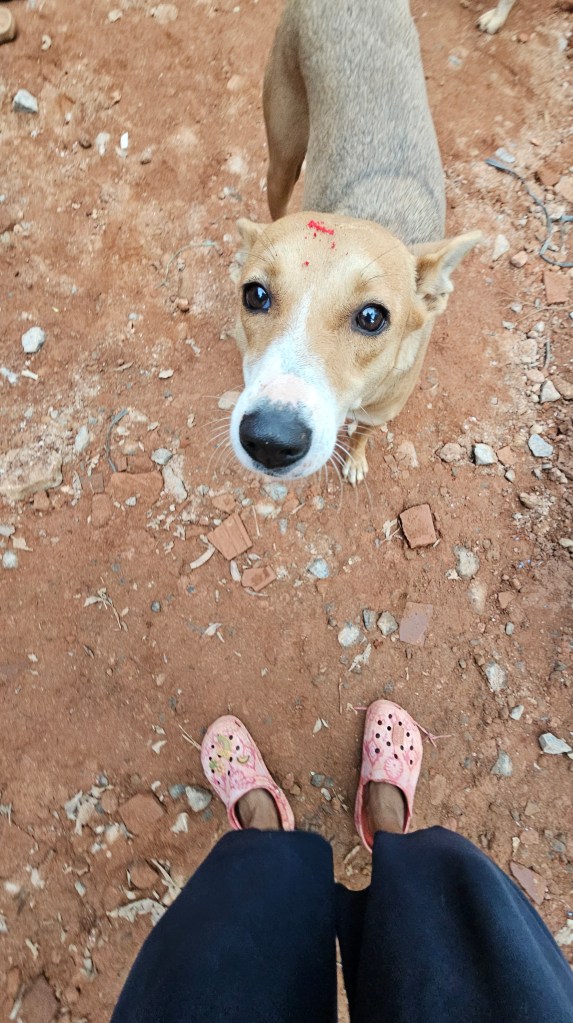
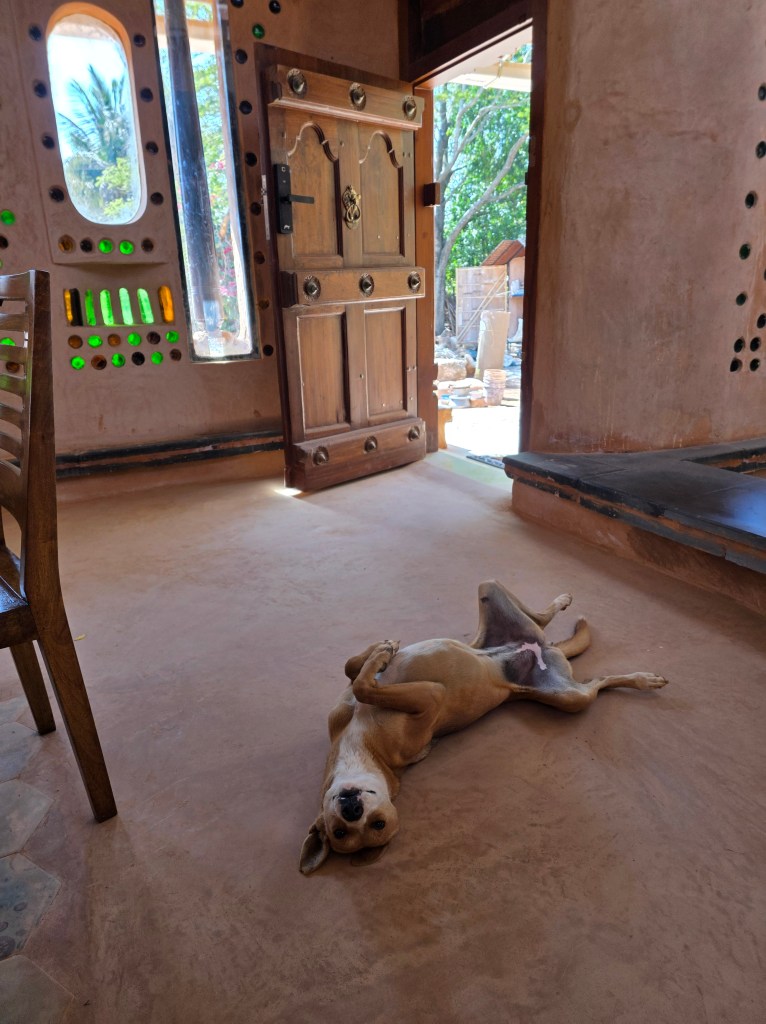
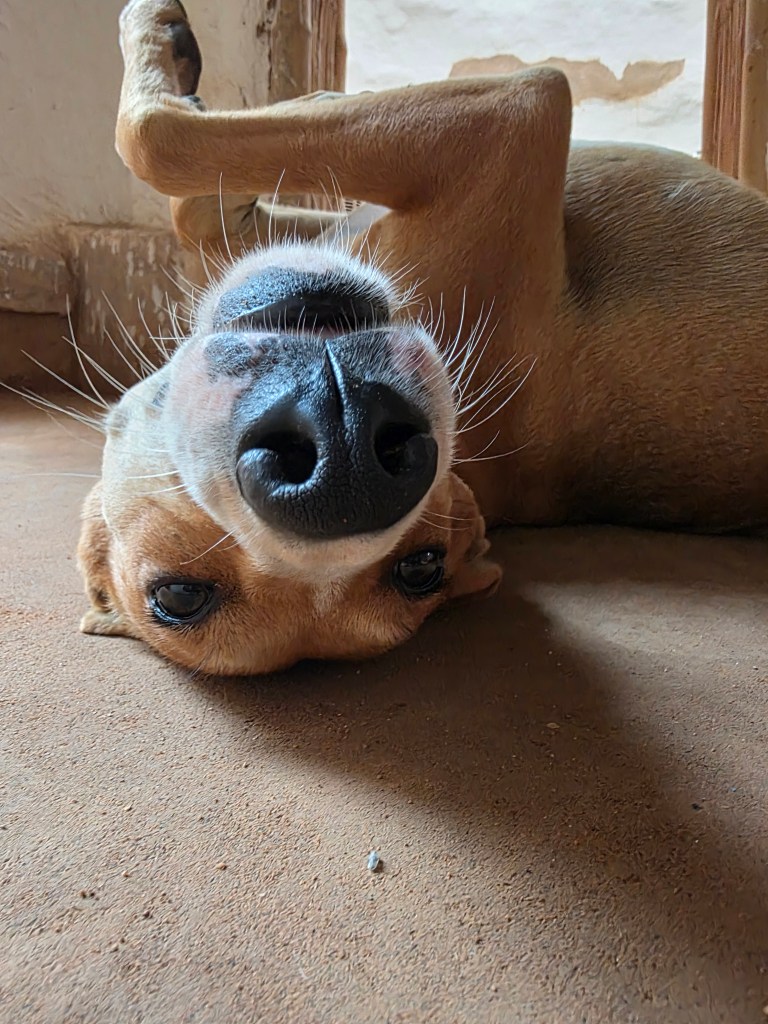
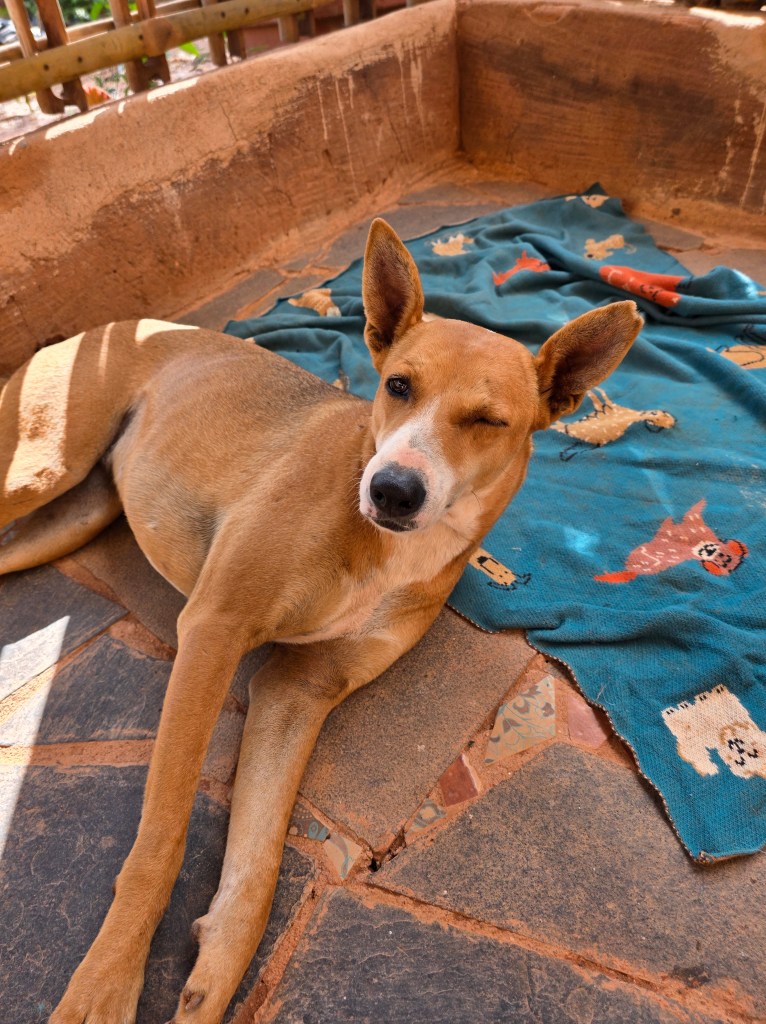
Today, I want to write about Yaya. If you’ve been following our Lives of Farmies series, you’ll recognise her as one of Chaita’s daughters. I’ve written about her father, Dude, and her mother, Chaita. Yaya, however, is like neither of them. She is entirely her own being.
The word that comes closest to describing Yaya is one I use very deliberately: equanimous.No matter what life throws at her, she seems largely unmoved. That is not to say she is indifferent or unaffectionate. Quite the contrary—she is gentle, present, and warm. Every morning she shows up to greet me, to receive her pets. She shows up every time I return home, seemingly pleased, but never overwhelmed.

RECAP : Lives of Farmies
If you missed our earlier blog that introduces our protagonists and want to catch up on that first, here you go.
The word that comes closest to describing Yaya is one I use very deliberately: equanimous.
This stands in sharp contrast to her sister Iti, who seems to have a small emotional collapse every time I return, or her mother Chaita, who is delightfully inconsistent—sometimes affectionate, sometimes entirely dismissive. Yaya, instead, occupies a space that feels… balanced. Interested, but not overwhelmed. Engaged, but not consumed. It is, I realise, the exact state of mind I aspire to.
Yaya occupies a space that feels… balanced. Interested, but not overwhelmed. Engaged, but not consumed. The exact state of mind I aspire to.
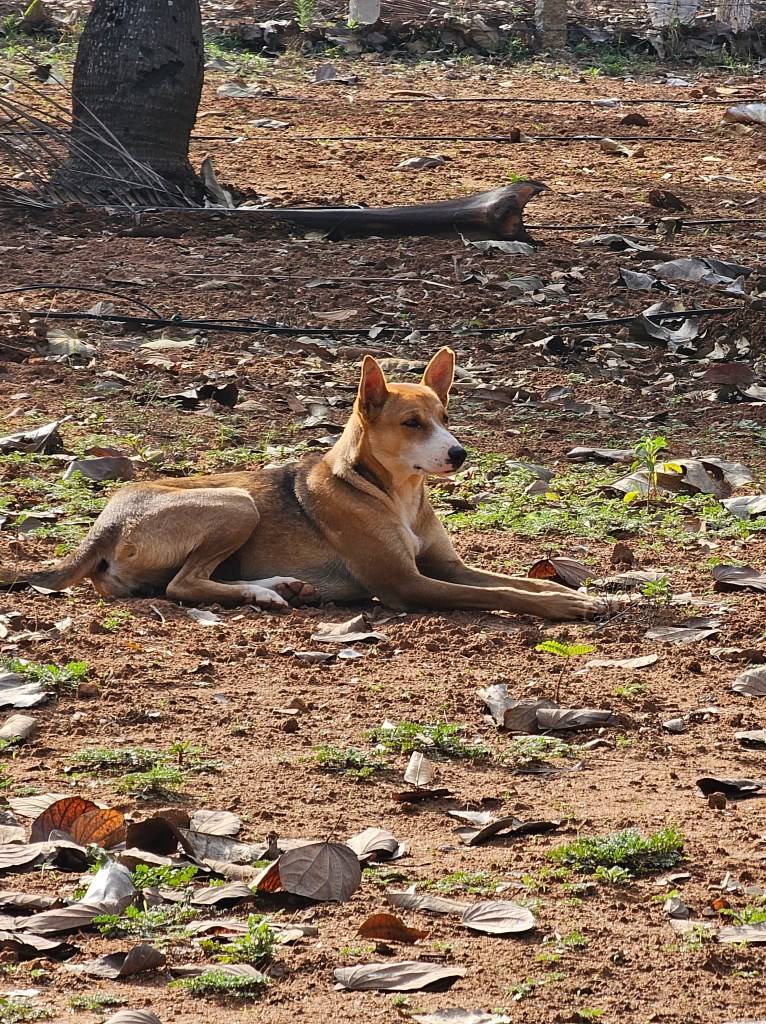
I have seen Yaya lying on my property, resting as heavy machinery roars just a few feet away from her—sounds that leave me frayed and on edge. And yet, she remains undisturbed. Watching her in those moments, I find myself wishing I could access that same ease. It reminds me, uncomfortably but clearly, that comfort is not always dictated by what surrounds us, but by the state of mind we bring to it.
Comfort is not always dictated by what surrounds us, but by the state of mind we bring to it.
I am struck by this again when I drive through the city and see dogs sprawled out in what seem like the most inhospitable conditions—legs splayed, bellies exposed, eyes closed, sleeping deeply amid traffic, noise, and the constant movement of people. Their stillness feels so complete that I have, more than once, stopped to check if they are alright. They wake, stretch, and wander over for a few gentle pets—calm, unbothered, entirely at ease. There is something quietly humbling about how little they seem to need, and yet how effortlessly they possess something I find myself striving for.
There is something humbling about how little they seem to need, and yet how effortlessly they possess something I find myself striving for.
The loss of my husband—my childhood sweetheart—deepened my anxiety disorders to the point where I was nearly non-functional. Slowly, painstakingly, I have pulled myself back from that edge. But anxiety still lingers, and it has sent me on a quest for peace. That search led me to Vipassana—a meditation practice whose name roughly translates to “looking inward.” At its core, Vipassana trains attention toward bodily sensations.
Most emotions, after all, are first felt in the body. The tightness in the chest. The flutter in the stomach. The heat rising in the face. Often, these sensations emerge before the mind has constructed a story around them. We’ve all experienced that vague unease—“I feel anxious, but I don’t know why.” The body knows before the mind does.
Contemporary theories of emotion, such as those proposed by Lisa Feldman Barrett, suggest that emotions are not simply reactions, but constructions—interpretations the brain generates to make sense of bodily sensations. In this view, what we call anxiety may be, at least in part, the mind’s attempt to explain the signals it receives from the body.
Contemporary theories of emotion, such as those proposed by L.F. Barrett, suggest that what we call anxiety may be the mind’s attempt to explain the signals it receives from the body.
Vipassana works directly with this. The practice is deceptively simple: observe the sensation. Stay with it. Watch it, without reacting, until it changes or fades. And then repeat. Again and again.
Over time, the idea is that the body learns to process sensations without escalating them into full-blown emotional narratives. The practitioner becomes less reactive, more observant. Feelings arise, but they do not take over. The goal is not numbness. It is familiarity without amplification. Awareness without entanglement. Equanimity.
The training itself is intense—ten hours a day, for ten days, in complete immersion. And even that is only the beginning. To sustain the practice requires daily commitment, often for years. And yet, here is Yaya. A street dog. Seemingly existing in the very state that humans spend years striving toward.
It is tempting to romanticise this—to call her enlightened, to project spiritual narratives onto her being. But that is not the point I want to make. Instead, I want to use Yaya to ask a different question: What if the “animal state of mind” is not lesser—but simply different?
What if the “animal state of mind” is not lesser—but simply different?
This is not to suggest that all dogs exist in this state. Iti, Yaya’s sister, is far more tightly wound—quick to react, quick to escalate. Individuals differ, as they must, because sentience allows for variation. But that is precisely what makes this so compelling. The fact that some animals appear capable of this kind of internal ease—the very state many humans labour to cultivate—raises uncomfortable questions. I sometimes feel faintly ridiculous, like Po in Kung Fu Panda searching for “inner peace,” while Yaya seems to inhabit it without effort. It leaves me wondering what it is about my own mind that keeps this state just out of reach, while she accesses it so naturally.
Human beings, especially in the post-Enlightenment tradition, tend to equate cognition with superiority. Our ability to analyse, plan, reflect, and narrate becomes the benchmark by which we measure intelligence—and by extension, worth. And yet, many of us spend our lives trying to quiet the very minds we celebrate.
Human beings tend to equate cognition with superiority. And yet, many of us spend our lives trying to quiet the very minds we celebrate.
Meditative traditions like Vipassana—over 2,000 years old—exist precisely because our cognitive capacities often generate suffering. The internal chatter, the rumination, the anticipatory anxiety—these are not trivial burdens. They shape our mental health, our relationships, and arguably, even the harm we inflict on each other, on other species, and on the planet.
So what, then, is a superior mind? Is it the endlessly analytical one? Or the one that can observe without being consumed?
What is a superior mind – the endlessly analytical one or the one that can observe without being consumed?
When people wonder what their dogs are “thinking,” scientific caution often leads us toward minimal explanations. This caution is often formalised in what is known as Morgan’s Canon, proposed by Conwy Lloyd Morgan, which advises that animal behaviour should not be interpreted in terms of higher psychological processes if it can be explained through simpler ones.
From that perspective, complex mental states are often dismissed as anthropomorphic projections. But this raises a deeper question. What if simplicity is not the same as absence? What if what we are witnessing is not a lack of mental activity—but a fundamentally different kind of mind?
When a dog appears “lost in thought,” we know they are not replaying social embarrassments or worrying about the future. But those of us who live closely with animals also sense that something is happening—something that is neither empty nor easily reducible.
What if it resembles, in some way, the state Vipassana practitioners attempt to cultivate? A mind that registers experience without narrativising it. A mind that observes, without clinging or resisting.
What if what we are witnessing in animals is not a lack of mental activity—but a fundamentally different kind of mind? A mind that registers experience without narrativising it. A mind that observes, without clinging or resisting.
This possibility finds resonance in interdisciplinary work at the intersection of cognitive science and contemplative traditions. Thinkers such as Francisco Varela and Evan Thompson have explored forms of awareness that are pre-reflective and non-conceptual—modes of experiencing that do not rely on narrative construction or analytical interpretation. While these frameworks are typically applied to human consciousness, they raise an intriguing possibility: that what we are observing in animals may not be an absence of mind, but a different organisation of it—one less dominated by abstraction, and perhaps closer to direct experience.
I am acutely cognisant of the fact that we have no evidence for the ideas I have presented here and I am also aware that, given our existing scientific abilities, these ideas are currently impossible to prove or disprove. We are nowhere close to arriving at a consensus on what the “mind” is, let alone to demonstrate the nature of the “animal mind.”
Philosopher Thomas Nagel famously argued that even if other beings possess rich subjective experiences, those experiences may remain fundamentally inaccessible to us—not because they are absent, but because our cognitive architecture limits our ability to apprehend them. However, we can speculate—and perhaps we must—if we are to give scientific inquiry direction.
Nagel argued that even if other beings possess rich subjective experiences, those experiences may remain fundamentally inaccessible to us.
In that spirit, recent work in philosophy of animal cognition urges caution against prematurely collapsing complexity into simplicity. Kristin Andrews argues that avoiding bias is not achieved by defaulting to parsimonious explanations, but by remaining open to the full range of possibilities—including those that may appear uncomfortably complex. Similarly, Colin Allen and Marc Bekoff suggest that minds may exist along an evolutionary continuum, where differences between species are not categorical, but gradual.
If this is so, then the question is no longer whether animals have minds like ours, but whether our framework for understanding minds is too narrow to accommodate the kinds they may possess and if our hierarchical view of minds, claiming superiority of our minds is limiting in our quest to better understand the mind.
So I am not making a claim. This is only an invitation. The next time you see an animal sitting quietly, seemingly absorbed in nothing at all, perhaps pause. And consider the possibility that what you are witnessing is not emptiness—but a different way of being. A way that is, in some quiet and profound sense, already at peace.
About The Authors

Sindhoor is a canine behaviour consultant, a canine myotherapist, an anthrozoologist and an engineer by qualification. She researches free living dogs in Bangalore, India. She has presented her findings at major international conferences in the US, UK and has conducted seminars in Europe, UK and South America. She has been invited as an expert on several podcasts, including a few on NPR radio. She maintained a weekly column on dog behaviour, in The Bangalore Mirror for two years. She is a TEDx speaker, the author of the book, Dog Knows. National Geographic calls hers a ‘Genius Mind’ in the bookazine, Genius of Dogs. She is currently the principal and director of BHARCS. BHARCS offers a unique, UK-accredited level 4 diploma on canine biosociopsychology and applied ethology.
References
Andrews, K. (2020). The animal mind: An introduction to the philosophy of animal cognition. Routledge.
Allen, C., & Bekoff, M. (1997). Species of mind: The philosophy and biology of cognitive ethology. MIT Press.
Barrett, L. F. (2017). How emotions are made: The secret life of the brain. Houghton Mifflin Harcourt.
Goenka, S. N. (1994). The discourse summaries of S. N. Goenka. Vipassana Research Institute.
Morgan, C. L. (1894). An introduction to comparative psychology. Walter Scott.
Nagel, T. (1974). What is it like to be a bat? The Philosophical Review, 83(4), 435–450.
Thompson, E. (2015). Waking, dreaming, being: Self and consciousness in neuroscience, meditation, and philosophy. Columbia University Press.
Varela, F. J., Thompson, E., & Rosch, E. (1991). The embodied mind: Cognitive science and human experience. MIT Press.
 The BHARCS Blog
I’ll leave a comment here, since I don’t think that the website actually allows comments.
This article comports with how I have long thought of dogs. That is, dogs appear, to me, to possess greater or lesser equanimity. Unlike humans, I have not observed in dogs anything that resembles a deliberate and sustained pursuit of happiness. For the purposes of not belabouring my comment, I won’t bother with defining what I think the differences are between joy, happiness, and equanimity (but I do believe that there are distinct differences).
I only had my first exposure to free-roaming dogs two years ago. I had deliberate exposure when I joined a street dog observation tour in India in 2025. One of the other North American tour participants and I spoke frequently about whether the dogs that we observed in India were more resilient than Western pet dogs or simply had a higher tolerance for stress. Since then, I learned the phrase “allostatic buffer,” which describes the degree of an organism’s ability to withstand sensory input before it becomes burdensome, aka allostatic load.
I suspect that humans are uniquely coded to pursue happiness rather than equanimity (though not exclusively and certainly not all to the same degree). Given our biological neural capacity to have a multidirectional mind, we can find ourselves drawn into additional mental states such as happiness pursuit, ruefulness, overstimulating anticipation for imagined outcomes, or nostalgia among them. I think that most of those states arise from an internal adjustment to the ‘happiness imperative’ that I surmise without evidence that we have.
I was recently in Sri Lanka and sought out a blind free-roaming dog that I had heard about. Thanks to someone who knew approximately where he lives, I quickly found him and we got to know each other a little bit. He liked when I came to visit him. One day, I found him atop a construction sand pile, seemingly staring into the tuk tuk parking lot and calmly observing the goings-on. That’s what I would have thought with a sighted dog, anyway. What is a blind dog looking at when he is awake but not roaming? What is he thinking? What occupies him while he whiles away the time atop his sand pile?
I’m only an occasional meditator and am not well-versed in all of the language of meditation and contemplative practices. That said, hoping that I’m using the right words to convey my meaning, I suspect that dogs are not contemplative creatures. While Rocky the blind dog looks out at the parking lot, where he sometimes gets fed, my best guess is that he is not remembering the meal he got there yesterday, reflecting on how good his life is, or otherwise engaging in anything that a human monkey mind will bring up. I consider him as sitting squarely within what I can only describe as equanimity. Perhaps contentedness. He was likely fed. There were no immediate threats to him. He is along a street where he has lived, blind, for at least 8 years. There is nowhere that he needs to be, nothing that he needs to do, nothing to rue, and no speculative forecasting of his dinner plans for the evening.
What else could he possibly be doing, or experiencing, that differs substantially from what I describe as equanimity? For Rocky, absent draws into the self-dialogues about the past, and the future, and what could be, and all of the rest, the default state is equanimity. Of course, dogs can and do have various traumas and the memories thereof that affect both the size of their allostatic buffer and therefore load. But such things do not appear to draw them into something like ‘wishing for different’ but I theorize are only impacting the degree to which equanimity is experienced.
Can I do the same? In short bursts. However, I think where our fundamental difference arises is that he has nowhere else to be, except in some state of greater or lesser equanimity.
Allostatic buffer comes back here as a relevant consideration. I believe we can accept with little debate that different humans have different gradients of allostatic buffer. Likewise, free roaming dogs have, on average, and by necessity, a higher allostatic buffer than domestic dogs. When a dog has a sufficiently high buffer, and/or a sufficiently low allostatic load, the resulting effect is something that fits quite neatly within the definition of equanimity.
This was a very thoughtful article and I appreciated reading it.
LikeLiked by 1 person