
Let’s talk about dominance. Yes, it seems a bit dated to talk about it now, given my current audience is comprised mostly of scientifically aware R+ trainers, training school faculty, university students or professors. But bear with me…

First, let’s get the obvious out of the way. No, I do not believe dogs exhibit despotic dominance[1] over humans. So I vehemently object to using intimidation and aversives as a response to any dog behaviour. I hope we have that shared understanding, should you decide to read the rest of this blog.
I do not believe dogs exhibit despotic dominance over humans. So I vehemently object to using intimidation and aversives as a response to any dog behaviour.
Now let’s dig deeper. Bonanni and colleagues, in their paper titled “Age-graded Dominance Hierarchies and Social Tolerance in packs of free-ranging dogs.”[2], discuss wolf social structures, pointing out that it’s not built on despotic dominance, instead is an elder-based structure. The pack-elder enjoys a certain status, owing to their age. This is not a position despotically claimed and retained through fights and ritualised behaviours like posturing. This is very similar to elder-based structures in human societies with a community-centric culture, much like the one I grew up in. So I am intimately familiar with the kinds of relational dynamics that play out in such elder-based structures.
They point out that wolf social structures are not built on despotic dominance, instead is an elder-based structure.
Being part of such a culture does give me a form of “insider perspective” and I am well aware of the biases it brings. However, I am also conscious of the fact that I have three unique perspectives – one of someone who lives partly in an elder-based structure and partly in an individualised society; the other of someone who lives on a farm that has free-living dogs that live close enough for me to observe; the final one of someone trained to observe and document biographies of dogs in particular. Hence, I feel compelled to write this.
Before we proceed, we need to ask ourselves if wolf studies warrant such exploration within a discussion on dogs. Bradshaw and colleagues[3] argue that dog-social-structures may not resemble wolf-social-structures, as the two species are different enough to expect different social structures. I agree that dog-social-structures do have some key features that may not be seen in other canids. However, I do have reason to believe that one component of dog-social-structure is an elder-based structure. Paul and Bhadra, in their paper titled “The great Indian joint families of free-ranging dogs.”[4], compare the dog’s social-structure to a large Indian family, where elders play critical roles. This suggests a possible elder-based social-structure in dogs. This is a good enough reason for me to critically examine the lives of the free-living dogs I share my life with. I am well aware that I am bound to find something I am looking for. Nevertheless, it can’t keep me from looking, because I can’t help it.
Paul and Bhadra, in their paper titled “The great Indian joint families of free-ranging dogs.”, compare the dog social structure to a large Indian family, where elders play critical roles.
The story goes like this…I share my life with a family of four dogs who are on my property every day. I feed and pet them, so they tend to “hang out” in and around my property, but they have their own free lives and entanglements with other dogs. Most of this plays out close by and curious as I am, I go observe and sometimes interfere too. What can I say? I like dogs and I am too invested in them. I am also privileged to be one of the key characters in their lives. They like me a lot. I know all of this means that I cannot be an unbiased observer of their lives, but then again, according to the Uncertainty Principle, it is almost impossible to observe something without influencing it. So I will not pretend to be objective in this piece, but I will do my best to remain reflexive and honest, as I narrate “our story” and ponder. Sit back and enjoy before you jump into analysis-mode. Stories are meant to be savoured like good wine..
Chaita, The Matriarch
While I am a key character in this story, the lead character, as the title suggests, is Chaita – the mum. She lives with her daughters – Iti and Yaya and her mate, Dude.
In this family, Chaita could possibly be the elder. The group follows her lead. It was she who decided to move into the property in front of mine, when I first arrived here, three years ago. Her family slowly followed. Once she moved, she decided to be nice towards my late dog Cheeru, who did not particularly like Chaita. Chaita had a very particular way of placating Cheeru and her daughters quickly picked that up. While Chaita was nice to Cheeru, she is not always nice to all dogs. She often initiates conflict with other dogs and her family is prompt in joining her. It was Chaita who first befriended Elvis. Soon I noticed the rest of the family playing with him. Then suddenly Chaita changed her mind about Elvis and sure enough, a few days later, the entire group changed their attitude towards Elvis.
In this family, Chaita could possibly be the elder. The group follows her lead.
At this point, one starts to wonder if Chaita is really an elder or “just a dominant dog“? In 2009, Bradshaw and colleagues[5] conducted a study on a group of freely interacting dogs. It is not clear if these are studies on free-living dogs, or companion / captive dogs that are interacting with some limited freedom in a lab or other such facility. Regardless, they conclude that none of their observations supported the idea that dogs have a “dominant personality”. They clarify that some dogs may dominate certain social interactions. However, this remains a feature of that interaction and does not translate to a consistent personality trait in the dog.
Dominance is a feature of the interaction and does not translate to a consistent personality trait in the dog.
Chaita’s behaviour reflects this. While she may be calling the shots on where the group lives, who the group trusts and who the group gets into arguments with, she does not engage in any of the ritualised expressions of dominance with her own family. When it is meal time, much like mums of most species, she lets her daughters eat first. When I call the group to feed them, I often find her sitting in a quiet dark corner away from her raucous family. I often have to look out for her, find her in the dark, go feed her and stand guard by her, so her daughters don’t try to grab her food. If I am not around, she often goes hungry, letting her family eat it all. No wonder she is the smallest and skinniest of the group. She does like her creature comforts like the beds I offer, petting and brushing. But if Dude or her daughters start getting excited about any of them, she just walks away, leaving it all to them. I often catch her grooming her daughters and I catch the daughters running up to her and cuddling with her in a manner that suggests they are seeking connection. She is always very gentle and patient with them. She’s a great mum!
While Chaita may be calling the shots, she does not engage in any of the ritualised expressions of dominance with her own family. I often catch her grooming her daughters. She is always very gentle and patient with them.
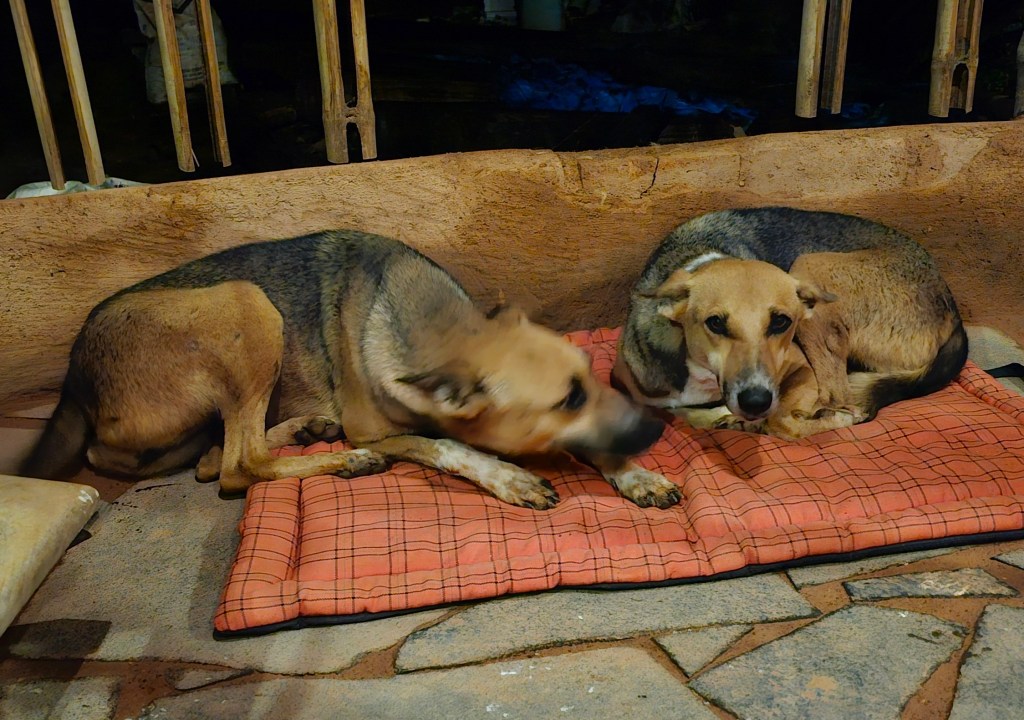
Chaita (right), being nudged out of her bed by her daughter Iti (left)
Chaita was also very accommodating of my late dog, Cheeru. Cheeru would often challenge her, but Chaita, the warrior, had nothing but placation to offer to Cheeru. However, this is the same Chaita who is battle-scarred, because she leads her family into. what seems to me as, unnecessary conflict. Our neighbours have fenced their property and confined a few dogs in there. I suspect the confinement frustrates them and they are constantly sitting at the part of the fencing they can look out from and barking at anyone who passes by. Chaita frequently takes their bait and gets into a shouting match with them. This acts as an instant call to her family. When her call comes, Yaya is usually sleeping at my feet, Iti is not far away and Dude is snoozing on a sand pile. The first to respond to the call is usually Iti. Yaya wakes up, stretches and then responds as if she is aware that this is not her fight, but as a good team player, she will show up. Dude responds depending on his mood. Some days he is lazy and slow to respond. Some days he has just been waiting for this and darts out eagerly. I watch in anguish as I know that soon I will be left nursing their wounds, if any.
Chaita was also very accommodating of my late dog, Cheeru. However, this is the same Chaita who is battle-scarred, because she leads her family into what seems to me as unnecessary conflict.
Chaita is neither a dominant dog nor a submissive one. She is a smart dog. She knows when it is a good idea to walk away from family tensions, when to placate dogs who may be useful to her and when to stand her ground. She is a confident dog, who, unlike Dude, does not bolt at the first sign of tension. She is a mum who has had to stand up and face challenges for her daughters and she continues to show that trait. She has a rapidly changing social scene and is often preoccupied with making friends and enemies, while recruiting her entire family into this drama.
Chaita reminds me a lot of some of our elders, particularly some of our matriarchs. Hence I suspect this family does seem to have something that looks like an elder-based structure. However, I do not think all dog groups have that. Not all dog groups are packs. Many are fluid groups of unrelated members. Elvis lives a somewhat solitary life, often seen “hanging out” with different sets of dogs in a very fluid group. A few of dogs that he hangs out with seem to lead somewhat similar non-familial lives. I do not know if those groups are as well coordinated as Chaita’s and I doubt there is an elder. If there isn’t one, the group dynamic is likely to be very different.
Chaita is neither a dominant dog nor a submissive one. She is a smart dog. She has a rapidly changing social scene and she is often preoccupied with making friends and enemies, while recruiting her entire family into this drama.

Chaita reminds me a lot of some of our elders, particularly some of our matriarchs.
Not all dogs live in social structures that resemble large Indian joint families. Some have small families, sometimes they live life as “singles” and sometimes it’s just two friends ageing together. I suspect that dog social structure can have a lot of variation, much like human social structure and this fluidity gives them a huge evolutionary advantage in an ecological niche dominated by humans. This adds tremendous complexity to their social structure and any form of dominance if at all, may only be a minor aspect of it.
Any form of dominance if at all, may only be a minor aspect of their complex social structure.
Time to wrap up our story now. There is more to tell and more to discuss, but today’s story ends here. Our discussion dredges up a lot of topics like the influence of patriarchy and colonialism on animal behaviour science, our understanding of matriarchy as opposed to matrilineality, the intersection of economics with dominance theories, the perspective of feminist literature on dominance theories in animal behaviour studies etc…I do deep dives on these in our workshops and Auditorium events. I also write about these as time permits. Today, I want to dive a little deeper into one of these aspects that our story brings up.
Be it wildlife-related TV shows or animal behaviour science papers, there is a disproportionate emphasis on hunting, fighting and mating. Animals do hunt, fight and mate, but that is a very small fraction of their lives. Why do we remain less curious about what they do with the rest of their time? Dogs are highly social animals and most of their time is spent in the company of humans or other dogs. They are engaging in a lot of social behaviours, many that do not even seem social (eg. social sleeping). They maintain intricate, complex and dynamic social webs through a lot of subtle behaviours like how they utilise joint attention to build a rapport with another individual.
Dogs maintain intricate, complex and dynamic social webs through a lot of subtle behaviours.
Bradshaw and colleagues[5] go as far as to challenge the very use of dominance models as the appropriate tool to understand animal behaviour and suggest alternatives to be considered. I concur. We have obsessed over domination for so long and it has not gotten us any closer to gaining a better understanding of dog-social-structures. Can we put a pin on that topic and consider getting curious about other aspects of a dog’s life? What models can we use to understand how they build and maintain friendships? How do family dynamics differ from non-familial group dynamics? What is being taught and learnt within free-living dog groups? How is social etiquette transmitted in free-living dog groups and do they vary from group to group? Would this be evidence of a form of “culture” in dog societies? What does non-violent conflict look like? So many questions, none of which can be answered with just the dominance framework.
And finally, my story is just an honest account of my experience. One person’s experience is not conclusive evidence and so we cannot claim categorically that dogs have elder-based social structures. However, our story does shed light on the kind of complexity that can be part of a dog’s social life. If this complexity is part of the dog’s ethogram, that brings up the question of its role in the dog’s welfare. This is a scary question to ask because it immediately raises lots of questions about the welfare of pet/companion / captive dogs, especially the ones whose social lives are highly curated and controlled. I do not pretend to have answers to these, but I would urge everyone to attempt to ask and answer such questions for themselves periodically. It will do us well to remain honest about this, wouldn’t you agree?
If you liked this story and would like to read more about Chaita and her friends, use the RECAP : Lives of Farmies link below.
RECAP : Lives of Farmies
If you missed our earlier blog that introduces our protagonists and want to catch up on that first, here you go.
About The Authors

Sindhoor is a canine behaviour consultant, a canine myotherapist, an anthrozoologist and an engineer by qualification. She researches free living dogs in Bangalore, India. She has presented her findings at major international conferences in the US, UK and has conducted seminars in Europe, UK and South America. She has been invited as an expert on several podcasts, including a few on NPR radio. She maintained a weekly column on dog behaviour, in The Bangalore Mirror for two years. She is a TEDx speaker, the author of the book, Dog Knows. National Geographic calls hers a ‘Genius Mind’ in the bookazine, Genius of Dogs. She is currently the principal and director of BHARCS. BHARCS offers a unique, UK-accredited level 4 diploma on canine biosociopsychology and applied ethology.
References
- Despotic dominance is in reference to use of posturing and agonistic behaviours to maintain rank or order.
- Bonanni et.al. 2017. Age-graded dominance hierarchies and social tolerance in packs of free-ranging dogs.
- Bradshaw et.al. 2009. Dominance in domestic dogs—useful construct or bad habit?
- Paul, M. and Bhadra, A., 2018. The great Indian joint families of free-ranging dogs.
- Bradshaw et.al. 2009. Dominance in domestic dogs—useful construct or bad habit?
 The BHARCS Blog
Love this ❤️
LikeLike
This was a treat to read!❤️
LikeLike